Pets at court: a short history of royal pet portraits
Putting a spaniel in a general’s coat feels like an internet joke. It is closer to a four-hundred-year-old habit: kings and queens have been having their animals painted, by name and at great expense, for as long as they have been having themselves painted.
First, beside the throne
For centuries the dog entered the royal portrait at its owner’s side. In 1533 Titian painted the emperor Charles V standing full length with one hand on the collar of a large hound, a picture now in the Prado in Madrid. A century later Anthony van Dyck painted the five eldest children of Charles I of England with an enormous mastiff in the middle of the group, the young prince resting a hand on its head. And in Velázquez’s Las Meninas of 1656, a sleepy mastiff lies in the foreground of the Spanish court while one of the royal attendants prods it with a foot.
The dog in these pictures does a job. It stands for loyalty, for the hunt, for a household rich enough to keep animals for pleasure. But it is already painted as an individual, and not as a symbol with fur.
Then, portraits of their own
At the French court the animals got canvases to themselves. Around 1702 Alexandre-François Desportes painted the favorite hunting dogs of Louis XIV for the château of Marly, each one a recognizable individual, with its name written on the canvas. His successor Jean-Baptiste Oudry did the same for Louis XV: his double portrait of the greyhounds Misse and Turlu dates from 1725.
These are real portraits. The dogs are shown close to life size in a landscape, alert and a little idealized, exactly as a courtier would be. Across the Channel, George Stubbs spent the second half of the eighteenth century doing as much for the horses and hounds of the English aristocracy.
Queen Victoria’s painter
No monarch loved a pet portrait more than Queen Victoria. In 1836, for her seventeenth birthday, her mother commissioned Edwin Landseer to paint her King Charles spaniel, Dash. Two years later, on the evening of her coronation, the new queen is said to have gone home and given Dash his bath.
Landseer became the court’s animal painter in all but name. In 1841 Victoria had him paint Eos, Prince Albert’s greyhound, as a Christmas present for her husband: the dog stands in profile beside the prince’s top hat and gloves, like an aide waiting for orders.
When the dogs began to dress up
It was Landseer, too, who tipped the genre into comedy. In 1840 he exhibited Laying Down the Law, in which a court of dogs plays out a trial, with a white poodle presiding as the judge. The joke is the one we still make: the pose and the setting insist on dignity, and the face belongs to somebody who chases his tail.
The idea spread and lost its inhibitions. From the 1880s Louis Wain filled English magazines with cats behaving like people, playing cards and taking tea. Across the Atlantic, in 1903, the painter Cassius Marcellus Coolidge was commissioned to paint a series of dogs in human company to advertise cigars. The ones gathered round a card table are the pictures everyone now knows as Dogs Playing Poker.
In the twentieth century the photographer William Wegman put his Weimaraners in suits and gowns, and the Belgian painter Thierry Poncelet began repainting the faces of antique family portraits as dogs, leaving the lace, the armor and the stern expressions exactly where they were.
From the court to the living room
What changed in our own time is who gets to commission. A royal portrait once took a court painter, months of work and a treasury. Then designers began cutting pets’ heads out of photographs and setting them on painted costumes. Now an image model can paint a new portrait from a single phone photo in about a minute, and a printer can put it on canvas within days.
The pleasure is the old one. A portrait in the grand manner says that its sitter matters. Hung over a sofa, it says that this particular dog, who once ate a sock, matters very much. Which is, after all, true.
Our six, and where they come from
Our own titles borrow from three of these centuries. The Duchess and The Queen wear the ruff and the lace collar of the years around 1600. The Princess belongs to the pastel portraits of the 1700s. The General, The Admiral and The Colonel wear the dress uniforms of the early 1800s, when no officer sat for a painter in anything less than full gold braid.
The artwork is made with AI and printed as a giclée on canvas: no court painter is involved, and we say so. The idea, though, is one that Louis XIV would have recognized at once.
The six portraits
-
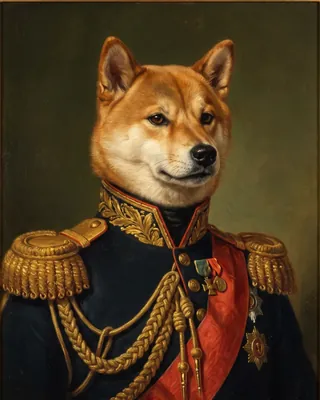 The GeneralNavy dress coat, gold epaulettes, red sash.Shown on a Shiba Inu.See The General
-
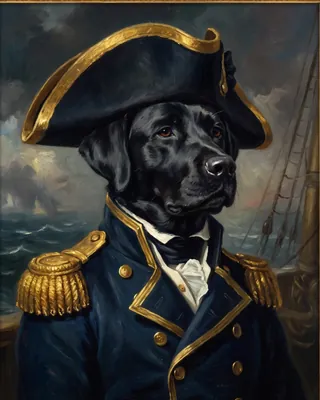 The AdmiralNaval coat, bicorne hat, a storm at sea.Shown on a black Labrador.See The Admiral
-
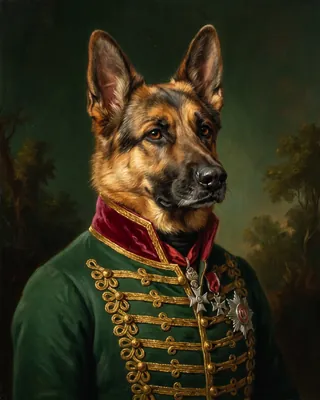 The ColonelGreen hussar jacket, gold braid, crimson collar.Shown on a German shepherd.See The Colonel
-
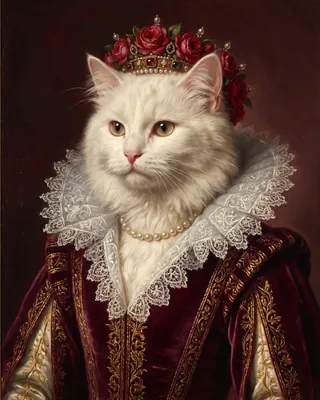 The QueenBurgundy velvet, lace collar, a crown of roses.Shown on a white longhair cat.See The Queen
-
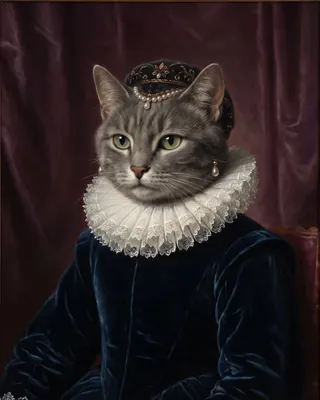 The DuchessMidnight velvet, lace ruff, pearls.Shown on a gray tabby.See The Duchess
-
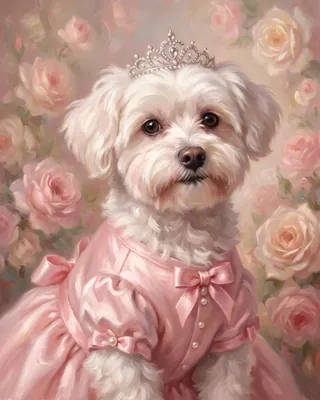 The PrincessPink satin, ribbons, a silver tiara.Shown on a Maltese.See The Princess
Keep reading
- How to photograph your pet for a portraitSix rules for a photo that makes a great portrait, and what to do about black coats and restless cats.
- Pet portrait size guide8 × 10, 11 × 14 or 16 × 20 inches: where each one works, and how high to hang it.
- Which royal title suits your pet?General, Admiral, Colonel, Queen, Duchess or Princess: a field guide by character and by coat.
- What is a giclée canvas print?What the word means, how the print is made, how long it lasts, and how to look after one.
- AI or hand-painted pet portraits: an honest comparisonPrice, time, likeness and what you actually receive, compared plainly. And when to commission a painter instead.
See your pet’s portrait first
Add one photo, choose a title, and your preview is ready in about a minute. It is free, and you only pay if you order.
Start with a photo